

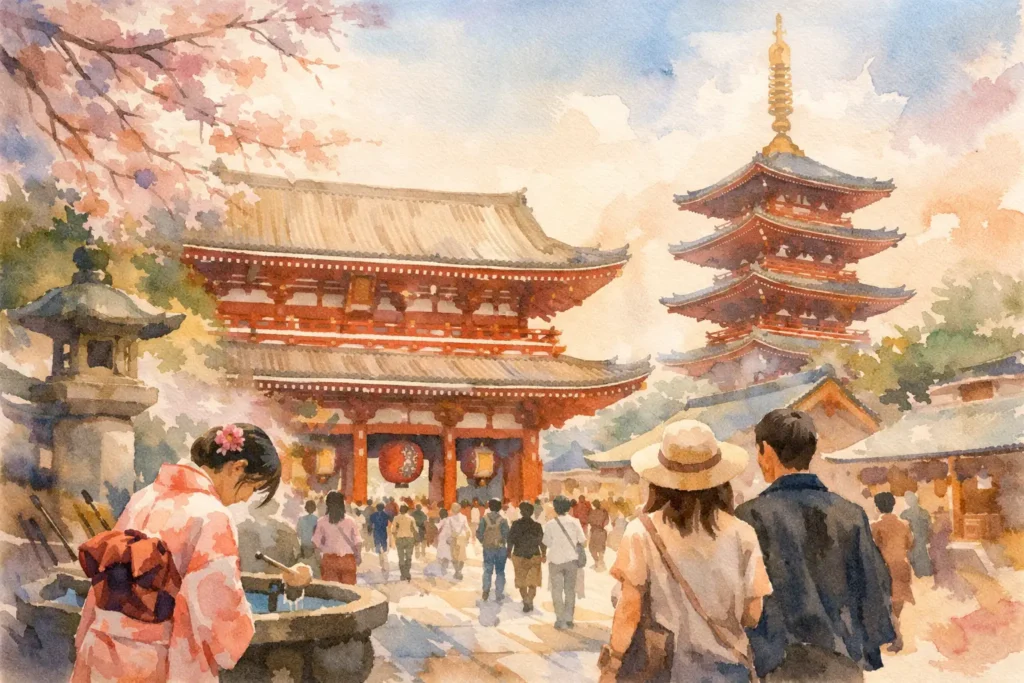
The great red lantern at Kaminarimon, the scent of incense drifting over Nakamise Street, and the magnificent tiled roof of the Main Hall make Sensō-ji feel wonderfully immediate. Yet this is not simply one of Tokyo’s most photographed landmarks. It is an active Buddhist temple, and understanding Sensoji temple etiquette for visitors changes the experience from a quick stop in Asakusa into a more meaningful encounter with a living spiritual tradition.
The reassuring news is that visitors are welcome. You do not need to be Buddhist, speak Japanese, or know every gesture perfectly. What matters is moving with care, observing the people around you, and treating prayer spaces as places of worship rather than backdrops for a photo.

Why Sensō-ji Feels Different From a Tourist Attraction
Founded in the seventh century and dedicated to Kannon, the bodhisattva of compassion, Sensō-ji is Tokyo’s oldest temple. Its approach can be exceptionally vibrant: school groups gather beneath the gates, rickshaws pass through the neighboring streets, and visitors browse traditional snacks and crafts along Nakamise. That energy is part of Asakusa’s enduring character.
Beyond the shopping street, however, the temple grounds invite a different pace. The Main Hall, known as the Hondo, is where people come to offer prayers for health, family, work, safe travel, and peace of mind. A respectful visit does not require solemn silence across the entire complex. It asks for awareness of when the atmosphere shifts, especially near the incense burner, the offering area, and halls where people are praying.
Sensō-ji is a Buddhist temple, not a Shinto shrine. Some customs overlap in the public imagination, but there is no need to force one set of rules onto every sacred site in Japan. Watch what regular worshippers do, follow posted guidance, and keep your gestures simple.

Sensoji Temple Etiquette for Visitors, Step by Step
Arrive through the gates with awareness
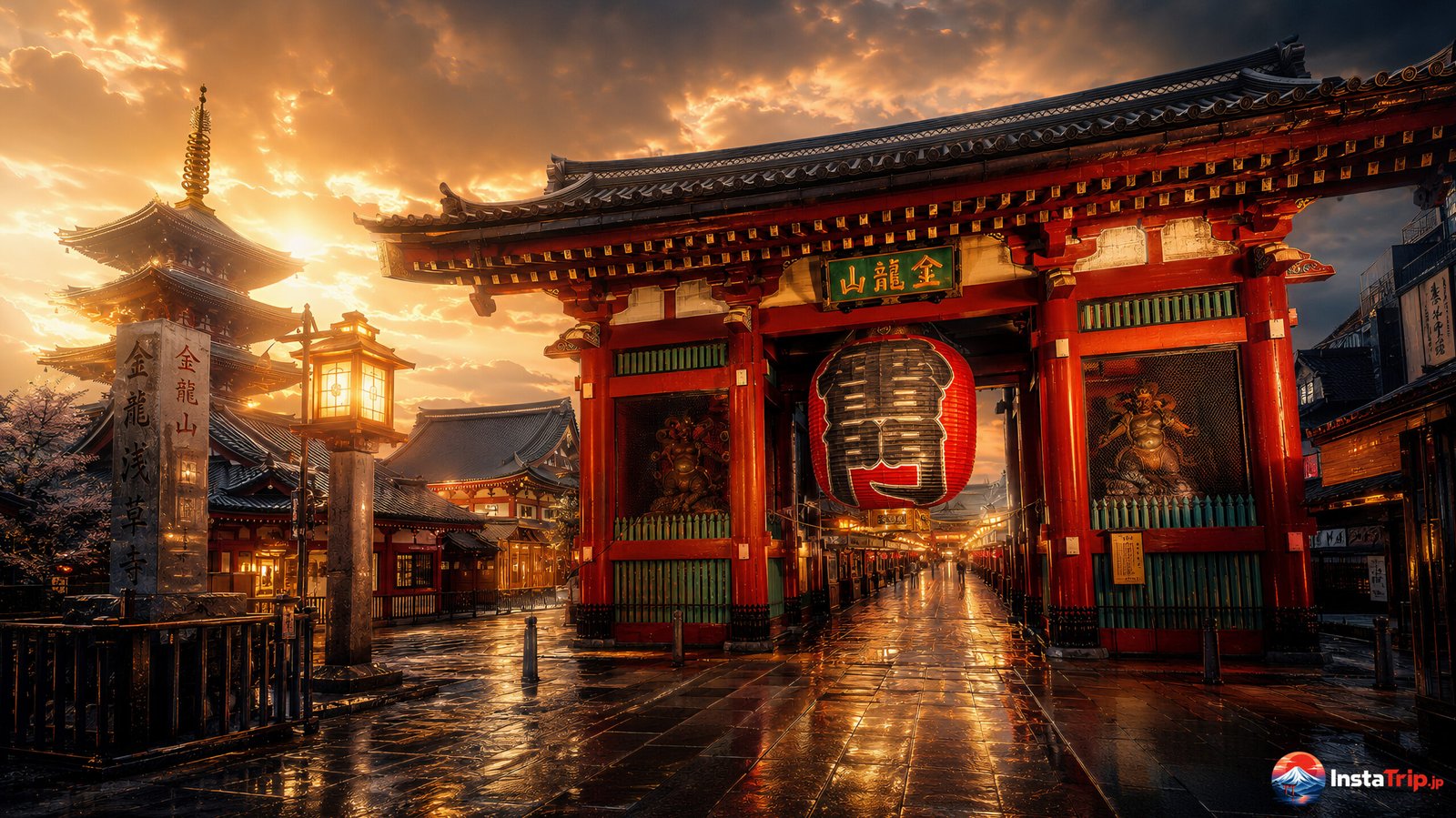
Kaminarimon, or Thunder Gate, is the celebrated entrance marked by its enormous red lantern. Take your photographs, admire the guardian figures, and allow room for others to pass. The central route beyond the gate can become crowded, so avoid stopping suddenly in the middle of the flow.
At a number of Japanese religious sites, the center of a gate or approach is treated as a particularly formal path. At Sensō-ji, the practical courtesy is the same: do not block the route, and avoid turning an entrance into a prolonged photo shoot. A small bow before entering is a gracious gesture, but it is not a test of cultural knowledge.
Purify your hands at the fountain
Near the Main Hall, you may find a purification fountain, often called a temizuya or chozuya. This ritual is a moment of symbolic cleansing before approaching a sacred space. It is best done calmly, without splashing or drinking from the ladle.
Take the ladle in your right hand and pour water over your left hand. Switch hands and rinse your right hand. Then pour a little water into your cupped left hand and use that water to rinse your mouth discreetly. Do not place the ladle directly against your lips. Finally, rinse your left hand again and tip the ladle upright so water runs down the handle.
If the fountain is busy, closed, or you are unsure of the sequence, it is completely fine to step aside. Clean hands and a considerate attitude are more valuable than performing a ritual hurriedly for the camera.
Approach the incense with respect
The large bronze incense burner in front of the Main Hall is among Sensō-ji’s most memorable sights. Visitors commonly place a small bundle of incense in the burner, then gently waft the fragrant smoke toward themselves. For many worshippers, the smoke carries an association with purification and well-being.
There is no need to push forward, make exaggerated gestures, or treat the smoke as a novelty. If you choose to participate, do so briefly and leave space for those waiting behind you. If you prefer simply to observe, that is equally respectful.
Offer a prayer in the Main Hall
At the hall’s offering area, you may place a coin in the offering box. Any modest amount is appropriate. Unlike the familiar shrine pattern of bows, claps, and prayer, Buddhist temple prayer is generally quieter: make an offering, bring your hands together, bow your head, and pray silently.
Do not clap at Sensō-ji’s Main Hall. You may see people lighting candles or incense through established temple areas, but follow the signs and instructions rather than improvising. The goal is not to reproduce a perfect ceremony. It is to create a brief, sincere moment without disrupting those who have come to worship.
Keep interiors quiet and camera-ready only where allowed
Sensō-ji’s grounds are visually captivating at every hour, particularly when afternoon light catches the vermilion structures or lanterns glow after dusk. Photography is generally part of the visitor experience outdoors. Inside halls and around active worship, though, restrictions may apply.
Look for signs before raising your camera. Do not use flash where it is prohibited, do not photograph people in prayer at close range, and never step into a restricted area for a better angle. If a space feels intimate or still, let that atmosphere guide you even when no sign is visible.
Omikuji, Goshuin, and Small Rituals Worth Understanding
Sensō-ji’s omikuji, or fortune slips, are a delightful way to encounter a temple custom. After making a small offering, visitors shake a metal container, retrieve a numbered stick, and match its number to a drawer holding the corresponding paper fortune. English instructions are often available, but the charm lies in taking the process slowly.
A difficult fortune is not a disaster or a prediction that must govern your trip. Traditionally, some visitors tie an unfavorable slip to a designated rack, symbolically leaving its misfortune behind. Others keep their fortune as a reflection or memento. Use only the marked tying areas, not railings, trees, or architectural details.
A goshuin is a temple calligraphy stamp, usually written by hand in a dedicated goshuincho book. It is a record of a sacred visit, not a collectible passport stamp. If you request one, approach the reception calmly, offer your book open to a blank page, and be patient if there is a line. A beautiful book of calligraphy can become a deeply personal travel keepsake, but it deserves the same care as any religious object.
What to Wear and How to Move Through the Grounds
Sensō-ji does not require formal clothing for ordinary visitors. Tokyo is a dynamic city, and travelers often arrive in practical walking clothes after exploring Asakusa, Ueno, or the Sumida River. Clean, comfortable attire is perfectly suitable.
The better question is whether your clothing and behavior suit a place where people pray. Avoid anything that feels deliberately disruptive, lower your voice near the halls, and keep bags, selfie sticks, and tripods from obstructing pathways. During festivals, New Year visits, and peak weekends, patience becomes part of etiquette. Crowds can be intense, so do not expect the grounds to provide a private, meditative scene at every moment.
Food from Nakamise’s lively stalls is part of the Asakusa experience, but finish snacks where appropriate and dispose of wrappers properly. Eating while moving through packed temple approaches can create unnecessary congestion. The same principle applies to smoking: use only designated areas.
The Courtesy That Matters Most
No visitor is expected to arrive at Sensō-ji with flawless knowledge of Japanese Buddhism. Customs vary among temples, and posted instructions always take priority over general advice. If you make a small mistake, there is no need to panic or make a spectacle of apologizing. Simply adjust, step aside, and continue respectfully.
Sensō-ji rewards visitors who pause long enough to notice its contrasts: the rhythmic bustle of Asakusa, the warm fragrance of incense, weathered traditions carried into modern Tokyo, and quiet prayers unfolding beneath a vast temple roof. Let those moments set your pace. The finest etiquette is not a memorized sequence of gestures, but the willingness to recognize that this magnificent place means something to the people who come here to pray.
![[商品価格に関しましては、リンクが作成された時点と現時点で情報が変更されている場合がございます。]](https://hbb.afl.rakuten.co.jp/hgb/574e9c46.c486f254.574e9c47.ad082c86/?me_id=1382162&item_id=10003827&pc=https%3A%2F%2Fthumbnail.image.rakuten.co.jp%2F%400_mall%2Fkatuuya2012%2Fcabinet%2F12757145%2Fcompass1783267136.jpg%3F_ex%3D128x128&s=128x128&t=picttext "[商品価格に関しましては、リンクが作成された時点と現時点で情報が変更されている場合がございます。]")