

Torii gate meaning: quick facts
What Does a Torii Gate Mean? Japan’s Sacred Threshold Explained
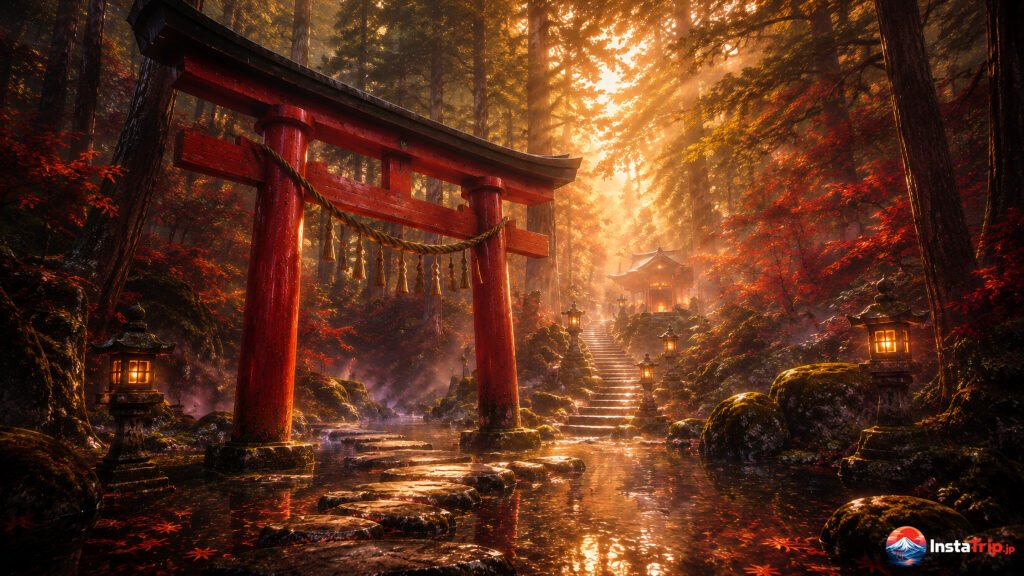
At the edge of a cedar forest, beside a mountain lake, or between ordinary city buildings, a torii can change the atmosphere before a single prayer is spoken. If you plan to worship after passing through the gate, our guide to praying at a Japanese shrine (神社参拝) explains the full sequence. Two pillars rise from the ground. One or more beams cross the sky above them. There is no door, no lock and usually no wall—yet the structure unmistakably tells you that something is different on the other side.
A torii (鳥居) is the open gateway that marks the entrance to a sacred Shinto space. Its central meaning is transition: it separates the ordinary, secular world from an area associated with the kami, the sacred presences or deities revered in Shinto. A torii is therefore not a barrier designed to keep people out. It is a threshold asking them to enter with awareness.
That simple idea explains why the torii has become one of Japan’s most recognizable symbols. But its mysterious name, uncertain origin, vermilion color, many architectural forms and proper etiquette reveal a far deeper story.

| Question | Short answer |
| What is a torii? | An open gateway marking the entrance to sacred Shinto space. |
| What does it symbolize? | The transition from the everyday world to the realm of the kami. |
| How is it written? | 鳥居, usually written とりい in hiragana. |
| Is “torii gate” redundant? | Technically, yes: torii already names the gateway, but “torii gate” is standard English usage. |
| Are torii always red? | No. They may be vermilion, natural wood, stone gray, white, black or made from modern materials. |
| What are the two main families? | Shinmei, characterized by straight lines, and Myōjin, usually recognized by curved upper beams. |
| Are torii Shinto or Buddhist? | Primarily Shinto, although historical religious syncretism created some exceptions. |
| How should you enter? | Pause and bow lightly, then pass slightly to the left or right rather than through the exact center. |

What does the word “torii” mean?
The Japanese characters are 鳥, meaning “bird,” and 居, meaning “to be,” “to sit” or “to reside.” Read literally, 鳥居 can therefore suggest a “bird perch.” That translation is real; the conclusion often attached to it is not certain.
Many popular explanations tell a vivid story. In Japanese mythology, the sun goddess Amaterasu Ōmikami withdrew into a cave, leaving the world in darkness. The other kami gathered long-crowing birds outside as part of their plan to draw her back into the light. Later tradition connected those birds, a supposed perch and the written characters 鳥居.
It is an evocative interpretation—but it should not be presented as proven history.
The actual origin of both the word and the structure remains unresolved. Specialists have proposed connections with India’s ceremonial torana, Chinese gateways, Korean sacred gates and native Japanese boundary markers made from posts and sacred rope. The Japanese Architecture and Art Net Users System records these competing theories while emphasizing that the origin is unclear.
What can be stated securely is that torii were established in Japan by the Heian period. A shrine property record dated 922 mentions them, showing that the form was already familiar by that time. The mystery lies not in what a torii eventually came to mean, but in exactly how it began.
A boundary between the ordinary and the sacred
The clearest torii gate meaning is not hidden in mythology. It is experienced through movement.
You approach from a road, a village, a station or a forest path. You stop before the gate. You pass beneath it. The surroundings may look almost unchanged, but in Shinto understanding you have crossed into a sacred precinct.
Japan’s Jinja Honcho, the organization that supports Shinto shrines throughout the country, defines the torii as the border between the secular and sacred worlds. The outermost gate marks the entrance to the shrine precinct; additional torii can indicate progressively more sacred areas as the visitor approaches the main sanctuary.
This is why some shrine approaches have an ichi-no-torii, or first torii, followed by a second and third. The sequence does more than decorate the path. Each threshold prepares the visitor to leave ordinary distractions behind and approach the kami with greater attention.
The torii’s openness is essential. Unlike a defensive city gate, it rarely contains doors. It does not physically prevent entry. Its power depends on recognition: the visitor sees the boundary and chooses to cross it respectfully.
Why are so many torii gates red?
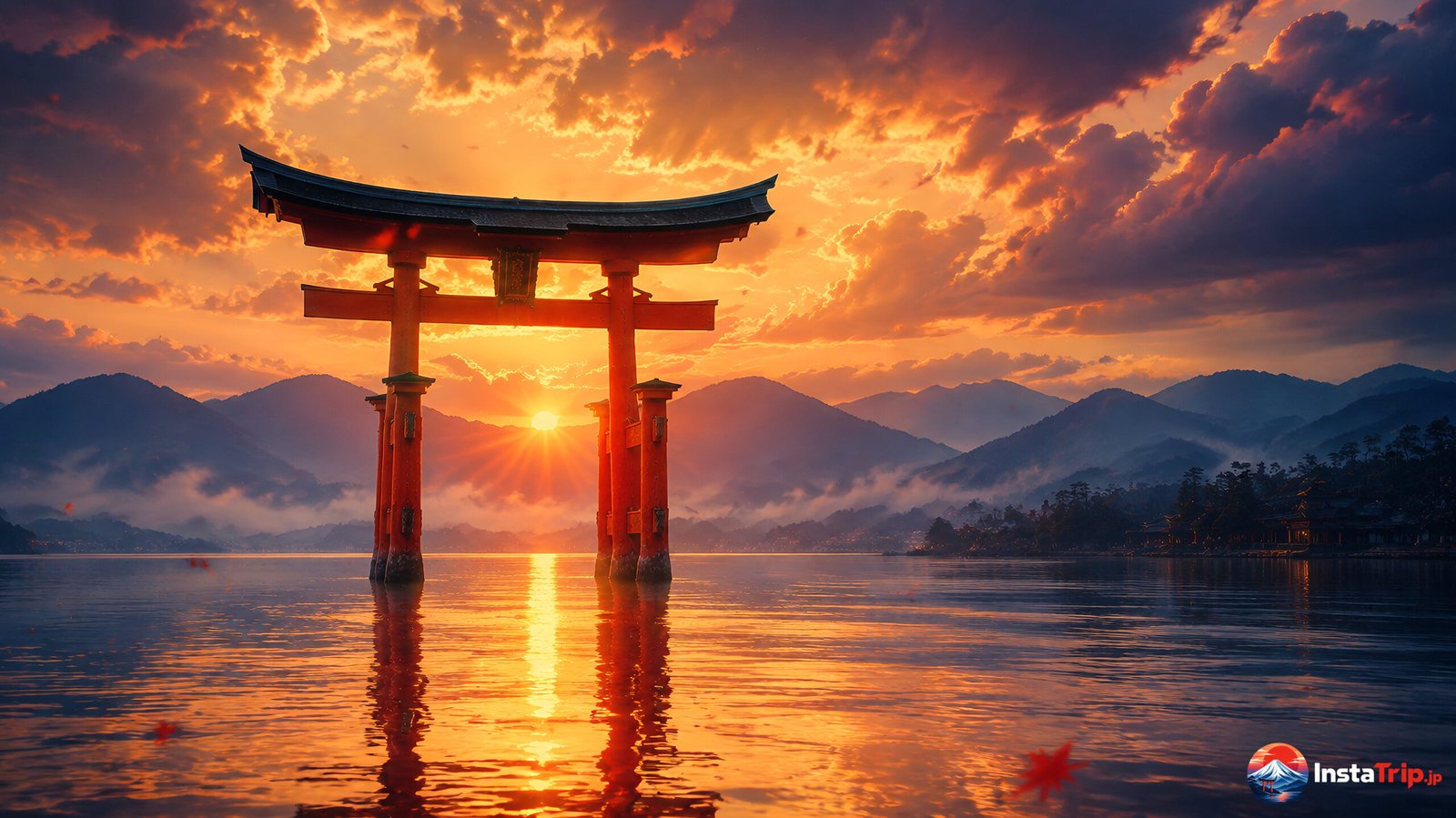
The famous “red” of many torii is more accurately vermilion, a vivid red-orange traditionally seen across shrine and temple architecture.
There is no single explanation for the color. Several meanings and practical reasons overlap:
- Protection: Vermilion has long been regarded as a color capable of resisting evil, misfortune and harmful forces.
- Vitality and light: At Fushimi Inari Taisha, the color is associated with brightness, hope, life, the earth and productive abundance.
- Preservation: Traditional cinnabar-based vermilion pigment had properties that helped protect wooden structures from decay and insects.
- Religious history: Vermilion architecture also reflects the long interaction between Shinto and Buddhism, which were deeply intertwined for centuries.
The official Fushimi Inari Taisha FAQ explains both the protective symbolism and the historical use of mercury and red earth to preserve wood. JNTO likewise notes the practical and cultural layers behind vermilion torii.
Are all torii red?
No. The image is iconic, but it is not universal.
At Ise Jingu, torii appear in pale, natural wood, expressing an austere architectural tradition. Other shrines use weathered stone, concrete, bronze, steel or stainless steel. Some regional and contemporary examples are white, black, yellow, blue, pink or even made from glass and ceramic.
Color alone therefore does not define a torii. Its function as a sacred boundary—and its recognizable arrangement of pillars and crossbeams—matters more.
The architecture of a torii
From a distance, a torii appears almost effortless. Its simplicity, however, is carefully constructed.
| Japanese term | Architectural role |
| Hashira (柱) | The two main vertical pillars. |
| Kasagi (笠木) | The uppermost horizontal lintel resting across the pillars. |
| Nuki (貫) | The lower tie beam passing through or connecting the pillars. |
| Shimaki (島木) | An optional secondary lintel directly beneath the kasagi. |
| Gakuzuka (額束) | An optional central strut that may support a plaque displaying the shrine’s name. |
| Kusabi (楔) | Wedges that help secure the nuki and may also serve a decorative role. |
Architectural historians classify numerous variations, but most belong broadly to two families.
Shinmei torii: straight and restrained
The Shinmei family is identified primarily by straight upper members and an uncluttered silhouette. Its simplest form consists of two pillars, a straight kasagi and a nuki. The visual effect is elemental: vertical posts, horizontal sky, little ornament.
Variations include the forms associated with Ise Jingu, Kashima shrines and other traditions. Natural or unpainted wood is common, although material and color are not absolute rules.
Myōjin torii: curved and expressive
The Myōjin family usually has upper lintels that curve gently upward at the ends. The pillars may incline slightly inward, and a central plaque is more common. This is the silhouette many people imagine when they picture a vermilion Japanese torii gate.
The family includes distinctive variants such as:
- Inari or Daiwa torii, recognizable by rings at the top of the pillars.
- Ryōbu torii, reinforced by additional supporting posts; Itsukushima Shrine’s great gate is a celebrated example.
- Sannō torii, crowned by a small gable-like form.
- Miwa torii, composed of three connected gateways.
These variations show that the torii is not one frozen design. It is an architectural language that different shrines, regions and religious histories have shaped over centuries.
Why does Fushimi Inari have thousands of torii?
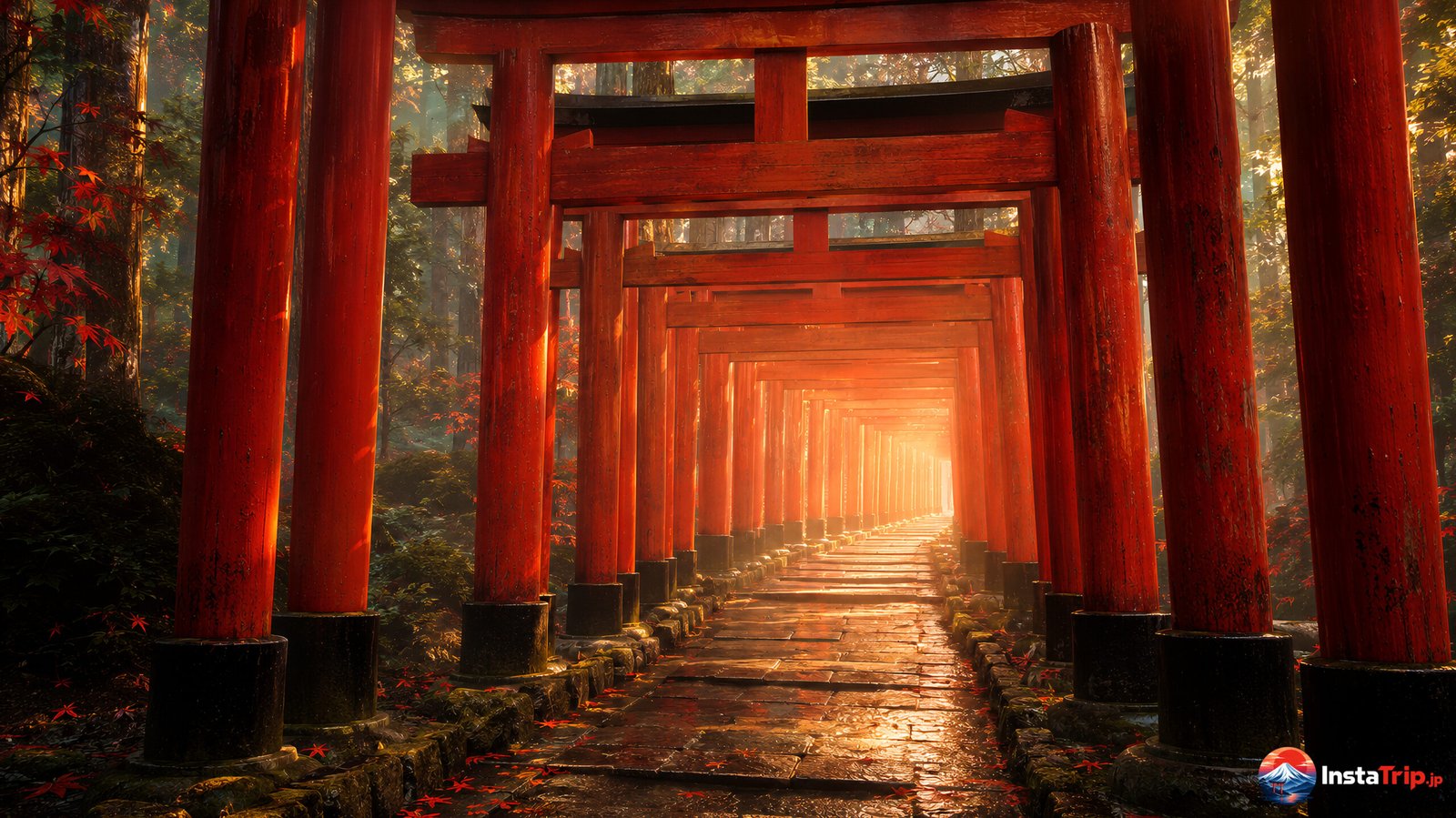
The vermilion tunnels of Fushimi Inari Taisha in Kyoto are among the most photographed scenes in Japan. They are also frequently misunderstood as mere decoration.
Each torii is an offering.
By the beginning of the Edo period, worshippers were donating torii to express a prayer or gratitude for a prayer believed to have been fulfilled. The tradition became especially associated with Inari worship, which developed strong connections with agriculture, household safety, industry and business prosperity.
According to the shrine’s official website, around 10,000 torii of different sizes now line the mountain paths. The celebrated Senbon Torii, literally “thousand torii,” forms only part of this immense sacred landscape.
Seen from the front, the gates create an almost uninterrupted field of vermilion. Seen from the other direction, inscriptions reveal the people, families and businesses whose offerings built the passage. What appears to be one monumental artwork is actually the accumulated record of countless individual acts of hope and gratitude.
Are torii gates only found at Shinto shrines?
Torii are principally symbols of Shinto shrines, while Buddhist temples commonly use roofed gates called mon or sanmon. This remains one of the easiest visual clues for distinguishing a shrine from a temple.
The distinction, however, is not perfectly absolute.
For much of Japanese history, Shinto and Buddhism coexisted through a complex process known as shinbutsu-shūgō. Shrines stood within temple grounds, Buddhist figures were connected with kami, and architectural symbols crossed the boundaries that modern visitors often expect to be rigid.
As a result, a Buddhist site may still contain a torii where a Shinto shrine or syncretic sacred space is present. The stone torii at Osaka’s Shitennō-ji is a famous example. These exceptions are not mistakes; they are traces of Japan’s layered religious history.
How to pass through a torii respectfully
Visitors do not need to practice Shinto to enter a shrine. Jinja Honcho explicitly welcomes people of other faiths—or no faith—provided they respect the dignity of the sacred space.
The customary etiquette is simple:
- Pause before the torii. Face toward the shrine and make one light bow.
- Pass to one side. Avoid walking through the exact center, traditionally regarded as the route of the kami. A little to the left or right is sufficient.
- Treat the entire precinct respectfully. Once beyond the torii, the sacred area includes more than the main building. Keep your voice controlled and follow posted restrictions.
- Do not lean on, climb or damage the gate. A torii may be photogenic, but it is not a stage prop. Never carve, attach objects or throw stones at it.
- On the way out, acknowledge the shrine again. After crossing back through the torii, turn toward the precinct and offer another light bow.
This is customary conduct, not a performance that must be executed with anxiety. A quiet, sincere gesture matters more than theatrical precision. Individual shrines may also have local practices, so their instructions should always take priority.
Photography is usually permitted in outdoor areas, but never assume that every angle or ceremony is open to cameras. Avoid blocking worshippers, occupying the central path for a prolonged photo session or ignoring signs near the main sanctuary. Meiji Jingu’s visitor guidance, for example, restricts photography at the main sanctuary where people pray.
Five iconic torii gates in Japan
Japan’s most famous torii reveal how the same spiritual idea can transform a mountain, forest, lake, sea or city.
| Torii | Location | Why it matters |
| Senbon Torii, Fushimi Inari Taisha | Kyoto | Around 10,000 donated gates line the sacred paths of Inariyama, turning individual prayers into an immense communal landscape. |
| Ōtorii, Itsukushima Shrine | Hiroshima | At high tide, the great gate appears to float before the World Heritage shrine on Miyajima; at low tide, the seabed around it becomes accessible. |
| Ōtorii, Meiji Jingu | Tokyo | The shrine identifies it as Japan’s largest wooden Myōjin-style torii of its kind, measuring 12 meters high and 17.1 meters wide. |
| Heiwa no Torii, Hakone Shrine | Kanagawa | The “Gate of Peace” rises from Lake Ashi. It was erected in 1952 and later received its peace plaque in connection with the shrine’s anniversary and the 1964 Tokyo Olympics. |
| Oyunohara Ōtorii | Wakayama | This steel gateway marks the original site of Kumano Hongu Taisha. At 33.9 meters high and 42 meters wide, local official sources describe it as the world’s largest torii. |
Their scale attracts cameras, but size is not what makes a torii sacred. A small stone gate beside a neighborhood road performs the same essential role: it announces that the everyday world is about to open into another order of attention.
Frequently asked questions about torii gates
What does a torii gate symbolize?
A torii symbolizes the boundary and transition between ordinary secular space and a sacred area associated with the kami. Passing beneath it is a physical movement with a spiritual meaning: the visitor leaves everyday concerns behind and approaches with respect.
Why are torii gates often red?
The color is usually vermilion rather than pure red. It is associated with protection, vitality, light and blessings, while traditional pigment also helped preserve wooden structures. However, not all torii are vermilion.
Is a torii gate religious?
Yes. Although the torii is widely used today as a visual symbol of Japan, its primary cultural role is religious: it marks sacred Shinto space. It should therefore be treated respectfully rather than simply as decorative architecture.
Can tourists walk through a torii gate?
Yes. Shrine grounds generally welcome visitors regardless of religion. The customary approach is to bow lightly before entering and walk slightly to one side instead of through the exact center.
Why are there several torii at one shrine?
The outer torii marks the entrance to the overall shrine precinct. Additional gates may indicate increasingly sacred zones on the approach to the main sanctuary. At Inari shrines, large numbers of torii may also be votive offerings donated by worshippers.
What is the difference between a torii and a Buddhist temple gate?
A torii is an open Shinto gateway, usually formed from two pillars and horizontal beams. A Buddhist temple gate is generally called a mon or sanmon and often has a roof, doors or guardian figures. Historical Shinto-Buddhist syncretism created exceptions.
Does torii literally mean “bird perch”?
The characters 鳥居 can be interpreted literally that way, but the true etymology remains uncertain. The popular connection with birds and the myth of Amaterasu is a meaningful tradition, not a conclusively established origin.
A gate that changes the way you enter
The torii’s power comes from doing something architecture rarely does: creating a boundary without closing it.
It does not demand belief before allowing passage. It offers a moment of recognition. Outside lies the familiar rhythm of trains, traffic, conversations and plans. Beyond it may be a forest, a courtyard, a mountain, a mirror of water—or simply a small neighborhood sanctuary holding centuries of local memory.
The next time you stand before a torii, look beyond its color and its perfect silhouette. Pause. Notice the space it frames. Then cross slightly to one side.
The landscape may not change at all. Your attention might.
Authoritative sources and further reading
- Encyclopedia of Shinto: Torii — Kokugakuin University
- JAANUS: Torii — Japanese architectural terminology
- Jinja Honcho: Entering a Jinja
- Jinja Honcho: Torii and shrine questions
- JNTO: Shrine and Temple Traditions
- JNTO: The Many Types of Torii in Japan
- Fushimi Inari Taisha: Official FAQ
- Itsukushima Shrine: Official website
- Meiji Jingu: Precinct map and Ōtorii
- Hakone Tourist Association: Hakone Shrine and the Gate of Peace
- Tanabe City Kumano Tourism Bureau: Oyunohara Ōtorii
![[商品価格に関しましては、リンクが作成された時点と現時点で情報が変更されている場合がございます。]](https://hbb.afl.rakuten.co.jp/hgb/574ea05e.a5106c72.574ea05f.cf3af89f/?me_id=1385407&item_id=10000001&pc=https%3A%2F%2Fthumbnail.image.rakuten.co.jp%2F%400_mall%2Fizumo-hiranoya%2Fcabinet%2Fitem%2Fdiscount%2Fb-1_10off_new.jpg%3F_ex%3D128x128&s=128x128&t=picttext "[商品価格に関しましては、リンクが作成された時点と現時点で情報が変更されている場合がございます。]")